If you’ve ever held a precision mechanical part—say, a custom bolt for a bicycle, a gear for a small robot, or a housing for a medical device—you might’ve wondered how it’s made. As a mechanical parts supplier, I work with CNC machining every single day, and it’s way more than just slapping metal into a machine and hitting “go.” It’s a step-by-step process that balances science, precision, and real-world problem solving, and I’m gonna break it down like I’d explain it to a new team member here. Mechanical Parts

First, let’s get one thing straight: CNC stands for Computer Numerical Control. That’s just fancy lingo for machines that follow exact digital instructions to cut materials, instead of a human hand cranking a drill or lathe. But before we even touch a machine, we’ve got to nail down the “what” and “why” of the part someone needs. That’s our first step: client consultation and design review.
When a client reaches out, they usually send a drawing or a 3D model of the part—sometimes with a vague note like “make it fit this housing” or “it needs to hold 500 lbs of force.” I don’t just jump straight to programming. First, we go over that model super carefully. Let’s say someone wants an aluminum gear for a drone: I’ll check if the tooth pitch is too tight for a 1/8-inch drill, or if the shaft hole is big enough to fit a standard fastener, or if the material they picked (6061 aluminum, most common for us) can handle the vibration the drone will put it through. We also talk about lead times. If they need the gear in 3 days, we’ll skip some secondary steps to get it out fast; if they need 1000 for a production run, we’ll optimize the cut to save material, which keeps costs down for them. Last month, a client sent a model of a stainless steel bracket that was way too thin (0.02 inches) for our mill to hold without wobbling. I didn’t just say “no” — I suggested adding a tiny temporary tab, which let us machine it correctly and saved them from reordering. That’s the kind of back-and-forth that sets good suppliers apart.
Next up: programming the CNC machine. This is where the digital design becomes a set of step-by-step commands the machine understands. We use CAM software (Computer-Aided Manufacturing) for this—we take the client’s 3D model, tell it what material we’re using, what tools we’ve got (drills, end mills, face mills), and then the software spits out G-code. G-code is just a bunch of numbers and letters that tell the machine where to move, how fast to spin the tool, how deep to cut, and when to change tools. But here’s the thing: I don’t just hit “generate” and walk away. I tweak that code. For example, if we’re cutting a part from a solid block instead of a smaller piece, I’ll adjust the tool path to leave just enough material for finishing cuts—so we don’t waste time cutting too much too fast, which can cause tool breakage or rough edges. If a part has tight tolerances (like ±0.001 inches, which is thinner than a human hair), I’ll add a final “finish pass” that cuts 0.0005 inches at a time, to get that exact size. I’ve messed this up before—last year, I generated a code for a brass valve that cut a little too wide, and we had to scrap the first block. Now I triple-check the tool path before hitting run.
Once the code’s good, we set up the machine. This part’s physical—we grab the raw material (could be aluminum, steel, brass, even plastic like Delrin), clamp it to the machine’s worktable with vises or fixtures, then install the right tools into the tool holder. We’ll also do a “tool offset” here: basically, we measure how long each tool is, so the machine knows exactly where the tip is instead of guessing. Then we do a test run with a block of scrap material, or even a dry run where the tool moves without cutting, to make sure nothing collides. Collisions are the worst—they can bend a tool, crack the machine, or ruin a $500 block of titanium. I’ve seen a coworker skip the dry run and crash a drill into a worktable; it took 2 days to fix the machine, and we lost a client’s rush order. No shortcuts here.
Now, the actual machining process. There are two main types of CNC machines we use: mills and lathes. Mills spin a cutting tool to cut into a stationary piece, good for parts with flat surfaces, holes, or complex shapes (like that drone gear I mentioned earlier). Lathes spin the material while a tool cuts into it, perfect for round parts like shafts or bolts. For most custom parts, we use a combination. Let’s walk through a mill example: we start with a roughing cut—this is the big, fast cut that removes most of the material, leaving a little bit for finishing. The roughing tool is a solid end mill, usually bigger (1/2 inch or 3/4 inch) to take off lots of material quickly. We don’t want to slow this down too much, because roughing makes up most of the machining time. Then comes the semi-finish cut, where we use a smaller tool to get closer to the final shape, and then the finish cut, which uses a super sharp, precise tool to get the exact dimensions and a smooth surface. For a part that needs to fit tightly into another part, surface finish matters too—some clients want a matte finish, others want a super smooth one, so we adjust the feed rate (how fast the tool moves) and spin speed for that.
Wait, we also have secondary machining steps sometimes. Drilling and tapping—tapping is when we cut threads into a hole, so you can screw a bolt in. We use a tap tool for that, and again, if the hole is small, we take it slow to avoid breaking the tap. Then there’s deburring: when you cut metal, you get little sharp edges (burrs) left over from the tool. We use a sanding stick, a wire brush, or even a tumbler (a rotating drum with small pellets that rub against the part) to get rid of those. Burrs aren’t just sharp—they can make a part not fit right, or even cause damage when it’s in use. Last month, a client sent a gear back because a burr on the tooth edge caught on another part; we apologized, deburred it, and sent it back for free, but now we add a quick deburr step as standard for all parts.
Then, inspection. This is non-negotiable for us. We can’t send a part out if it’s not exactly what the client ordered. We use calipers, micrometers, and a CMM (Coordinate Measuring Machine) which scans the part to check dimensions against the 3D model. For tight tolerances, we’ll even use a height gauge or a dial indicator. We also check surface finish with a profilometer, which measures how smooth the surface is. If a part fails inspection, we don’t ship it—we either fix it (if it’s a small issue, like a slightly off hole) or scrap it and make a new one. A few weeks back, we machined 100 brackets for a client, and one was 0.002 inches too short. Instead of shipping it, we remade all 100, which cost us time, but it kept the client’s trust.
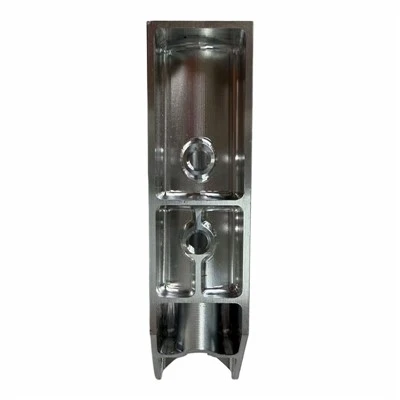
Then, finishing touches. This is optional, but a lot of clients want it. Anodizing for aluminum, which makes it resistant to corrosion and adds color. Powder coating, which is a thick, durable finish for steel. Passivation for stainless steel, to remove impurities and prevent rust. We also package the parts carefully—wrap them in anti-static plastic if they’re electronic components, put them in foam inserts so they don’t get scratched in shipping.
Auto Parts At the end of the day, CNC machining for mechanical parts is a mix of tech and hands-on know-how. It’s not just pushing a button; it’s checking the model, tweaking the code, avoiding mistakes, and making sure every part works like it should. If you need custom mechanical parts, whether it’s a small batch of prototypes or a large production run, we’ve got the experience to get it right. Reach out to our team to talk through your project.
References
- Smid, P. (2010). CNC Programming Handbook. Industrial Press.
- Dixon, J. (2019). Modern Machining Practices for Mechanical Parts. ASME Press.
- DeGarmo, E. P., Black, J. T., & Kohser, R. A. (2020). Materials and Processes in Manufacturing. John Wiley & Sons.
Dongguan Yixin Metal Products Co., Ltd.
With abundant experience, we are one of the most professional mechanical parts manufacturers and suppliers in China. Please rest assured to wholesale advanced mechanical parts made in China here from our factory. Good service and quality products are available.
Address: No.172, Daxing Road, Yangwu, Zhen, Dongguan City, Guangdong Province, China
E-mail: Chengxingfeng123@163.com
WebSite: https://www.zgdgyixin.com/
