If you’ve ever stood beneath a grid of humming high-voltage power lines stretching over hills, valleys, or busy highways, you might not have spared a second thought for the towers holding those lines up. As someone who’s spent 12 years running a small, specialized electrical tower stand supply business, I can tell you: that angle of those tower legs isn’t a random quirk of engineering—it’s the difference between a line that survives a blizzard, stands strong through hurricane-force winds, and doesn’t end up causing a hours-long outage for thousands of homes. Too many people treat tower stands as a one-size-fits-all commodity, but the angle at which we anchor each leg of the stand is where the science and the real-world performance meet. Let’s break down why that detail matters more than you might think, straight from someone who’s installed (and fixed) my fair share of these structures. Electrical Tower Stand

First, let’s start with the basics: what exactly is the angle of an electrical tower stand? In simple terms, it’s the angle between the horizontal ground and the legs of the tower’s base structure—where the stand meets the earth, not the tower’s upper crossarm that holds power lines. Most people assume this angle is a standard number, like 45 degrees, but that’s only true for flat, evenly drained land. Adjust that angle by even a few degrees, and you’re changing how the entire tower transfers stress, weight, and external forces.
Let’s talk about load first. A power tower isn’t just holding its own weight—its entire purpose is to suspend heavy power lines, which can weigh thousands of pounds, plus the insulators, conductors, and sometimes equipment for smart grid tech. That weight exerts a downward force on the tower, but it also creates a side pull: power lines sway in wind, ice and snow add weight that pulls downward unevenly, and even the wind itself pushes against the lines, leaning the tower. The angle of the stand’s legs is designed to counteract those forces. If the angle is too steep (meaning the legs are almost vertical), the stand can’t resist the side pull—think of a pencil standing straight up; a small nudge makes it fall over. If the angle is too shallow, the stand wastes material and money. A shallower leg needs longer, thicker steel to handle the downward force, which increases costs for utilities who build hundreds of miles of these towers. We engineer the angle to balance both: enough side stability to resist wind and ice, and enough vertical support to carry line weight, without overspending on unnecessary materials.
But here’s where the angle gets specific to site conditions, and where I’ve seen mistakes happen in the field. A few years back, I worked on a project in the Pacific Northwest, where utility companies were building a new line through a stretch of steep, uneven hillside. The contractor who bid on the initial job used a standard 45-degree angle for every tower stand, no matter the slope of the land. We got a call a month later: three towers had shifted on their stands, one had even leaned far enough to trigger a safety inspection. When we arrived, we realized the site wasn’t flat—half the towers were anchored on a 10-degree slope. A 45-degree angle on sloped ground is equivalent to a 35-degree angle on flat ground, which drastically reduces side stability. We had to re-engineer each of those stands: adjust the leg angle to match the slope, add bracing where needed, and reinforce the base. That job cost the utility company an extra $120,000 in rework and delayed service for a nearby small town—all because they skipped adjusting that angle to the site. That’s the kind of story that makes every adjustment of our stands feel personal to me; I don’t just sell a product, I sell a solution that works for where it’s going.
Another critical factor: environmental stressors, which vary wildly by region, and the angle of the stand is tailored to handle those. Let’s take the Southeast U.S., where hurricanes are a regular threat. For those regions, we use a slightly wider leg angle (around 50 degrees, depending on wind speed maps) to create a broader base that resists the horizontal force of 100+ mph winds. Contrast that with the Upper Midwest, where blizzards and heavy ice loads are the main risk. Ice can add 10 times the weight of a power line, pulling downward and creating a vertical stress that a shallower angle would handle better—so we use a slightly steeper angle there, around 42 degrees, to distribute that weight evenly without bending the base. I’ve even supplied stands for a project in Alaska, where permafrost is the ground surface. The angle there isn’t just about strength; it’s about preventing the stand from settling as permafrost thaws in summer. We set the legs at a 48-degree angle, anchored deep into the active layer of permafrost, so as the ground shifts, the stand stays aligned and doesn’t pull the lines out of tolerance. That adaptability—adjusting the angle to match local conditions—is what makes a good tower stand supplier valuable, not just someone who ships standard parts.
You might be wondering: why not just build the entire stand wider, like a triangle, for maximum stability? There’s a catch there. Power lines follow right-of-way corridors, which are often narrow, especially in urban areas or along highways. A wider stand angle means a broader base, which can take up too much space, encroach on roads, or run into property lines. That’s where precision in the angle comes in: we calculate the exact angle needed to meet both stability requirements and space constraints. For example, in a suburban right-of-way with only 10 feet of space for a tower base, we engineer a 47-degree angle that gives enough stability without needing a base wider than 8 feet, so the tower fits within the corridor without extra permits or land acquisition costs. That’s a detail that utilities appreciate, because every mile of right-of-way adds up to thousands of dollars in costs.
Let’s also touch on long-term performance and maintenance, which ties directly to the angle. A tower stand with the wrong angle will develop stress cracks over time, especially in the steel or concrete anchors. Last year, we had a utility client call us about a line in Pennsylvania that had developed 12 cracks in the stand bases after only 5 years. An inspection showed the angle was off by 3 degrees—too shallow, so the vertical weight of the lines was concentrating too much stress on the legs, leading to metal fatigue. Fixing it required replacing half the stands, which cost more than twice what the utility would have spent if we’d set the correct angle initially. That’s the kind of waste that comes from cutting corners on that engineering detail. For our business, we don’t just sell a stand and walk away; we work with utilities to survey each site, run load calculations, and adjust the angle to the exact specifications of that location. It’s a hands-on approach that small suppliers can offer that big box industrial companies can’t—we’re not just selling a part, we’re invested in the line lasting for 50 years, the expected lifespan of these towers.
Now, I know some people might say, “This sounds like engineering jargon—what does it mean for the people who use electricity every day?” Well, think about the last time your power went out. Most outages are caused by downed lines, and a large percentage of those are from towers failing because of bad base design. When we get the angle right, towers stand through storms, ice, and wind, so lines stay up, and homes, hospitals, and businesses keep power. That’s the real-world impact: that small adjustment to the tower stand’s angle doesn’t just save a utility money—it keeps the lights on for thousands of people.
I’ve been in this business long enough to see a lot of changes. When I started 12 years ago, many suppliers just used a standard 45-degree angle for every stand, no questions asked. But over time, utilities have come to understand that the angle isn’t a trivial detail—it’s a core part of the tower’s resilience. That’s why we’ve invested in engineering software that lets us calculate the exact angle for any site, from flat plains to mountain slopes, and we test every design against local climate data. We’ve even worked with a few renewable energy projects, like wind farms, where towers hold lines connecting turbines to the grid. Those sites have unique conditions: often windy, uneven ground, and need lines that don’t sag too much. Adjusting the tower stand’s angle there helped those projects avoid costly outages during peak wind season.
If you’re a utility engineer, a project manager, or someone responsible for building or maintaining power lines, I want you to take a look at your next tower stand order. Don’t just accept a standard size. Ask about the angle: is it tailored to your site’s slope, your region’s weather, your right-of-way constraints? As someone who’s seen the mistakes that happen when that angle is wrong, I can tell you it’s worth taking the time to get that detail right.
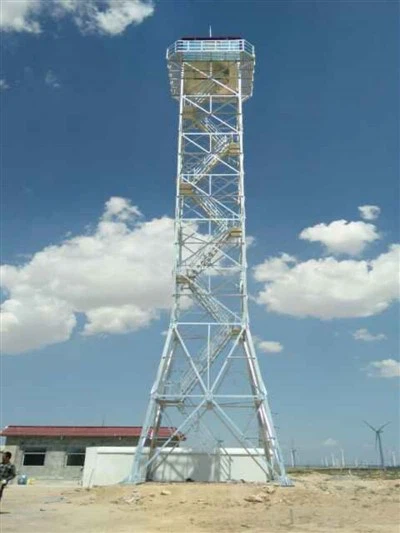
For anyone who’s involved in sourcing electrical tower stands, whether for a new line, a upgrade, or a replacement, I’m here to help. We work with projects of all sizes, from small local utility expansions to large regional transmission lines, and we’ll provide the engineering, site surveys, and custom angle adjustments your project needs to stand strong for decades. Get in touch with our team to discuss your requirements and learn how we can tailor our tower stands to your specific needs.
Monitoring Tower References
- American National Standards Institute (ANSI) C2: National Electrical Safety Code
- IEEE 1243: Guide for Improving the Lightning Performance of Transmission Lines
- Electric Power Research Institute (EPRI) Transmission Tower Design Guidelines
Hebei Yifeng Steel Structure Co., Ltd.
As one of the most professional electrical tower stand manufacturers and suppliers in China, we offer a wide range of products with superior quality. Please feel free to buy cost-efficient electrical tower stand for sale here from our factory. Contact us for more details.
Address: Guangchuan Town Industrial Zone, Jing County, Hengshui City, Hebei Province
E-mail: hbyfgjg@163.com
WebSite: https://www.yf-powertowers.com/
